
Endodontics in Barcelona
we save your tooth when it seems there's no solution
If you're here you probably have pain. Or you've been told you need a root canal and you're not quite sure what that means. Or you're scared. Maybe all three at once.
We'll tell you right away: today's root canal has nothing to do with the one from twenty years ago. And in most cases, what hurts most is waiting.
Book an appointment — we'll see you today if you can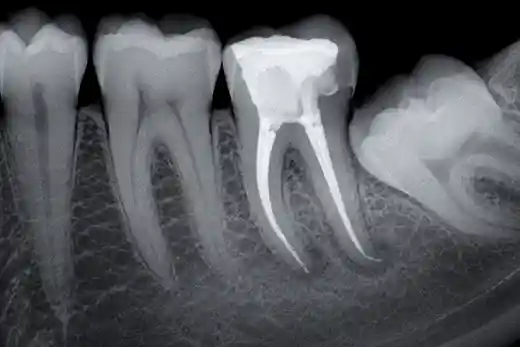
What exactly is a root canal?
The word is scary. We know. "Endodontics" sounds like a long, complicated and painful procedure. But there's something we want you to know before reading anything else: a well-done root canal saves a tooth that would otherwise have to be extracted. And keeping your natural tooth is always the best option.
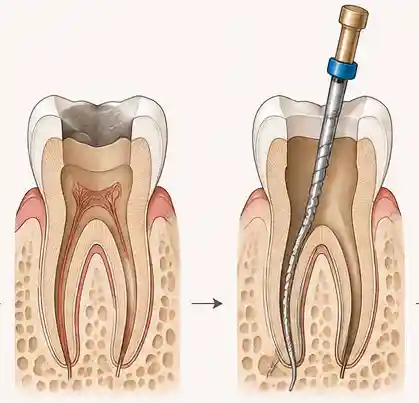
The inside of each tooth has a cavity called the pulp, where the nerves and blood vessels are. When that pulp becomes infected —from a deep cavity, a fracture or a blow— the pain appears. Sometimes very intense.
The root canal involves cleaning that infected pulp, disinfecting the inside of the tooth and sealing it so it can't get infected again. The tooth is left without a nerve, but completely functional. You can keep using it completely normally.
When is a root canal needed?
- Intense or throbbing pain in a tooth, especially when chewing or lying down
- Prolonged sensitivity to cold or heat that doesn't go away
- The tooth has changed colour (it has darkened)
- Swelling or a lump in the gum near the affected tooth
- Diagnosis of a very deep cavity that has reached the nerve
- A fractured tooth that has compromised the pulp
Why our patients trust us for a root canal
We know that when there's pain, what you want most is for someone to tell you what's happening and that they're going to fix it. Thirty-five years doing root canals have taught us something important: technique matters, but so does the peace of mind you give the patient.
Pain-free — really
Today's local anaesthesia is very effective. At our clinic we take the time needed for it to be properly applied before starting. If at any point you feel something, you tell us and we stop. We never continue if you're not comfortable.
35 years saving teeth others would extract
Whenever possible, we prefer to keep your natural tooth. We have spent more than three decades doing root canals and retreatments —the cases where a previous root canal didn't work— with a clear vision: extraction is the last option, not the first.
We explain what's happening
No terminology you don't understand. Before we start we show you what we see on the X-ray, explain what we're going to do and how long it will take. When you know what's happening, the fear goes down. A lot.
Same-day care if the pain can't wait
Acute dental pain shouldn't wait a week. When we can, we keep slots open for emergencies. Call us — if there's a slot that day, it's yours.
What is a root canal like? Step by step, no fine print
Fear of the root canal almost always comes from not knowing what's going to happen. So we'll tell you everything, from start to finish.
Diagnosis and X-ray
First of all, we need to see what's happening inside the tooth. With an X-ray we confirm the state of the pulp and the canals. At this visit we already know whether the root canal is the right solution and we explain it to you.
Local anaesthesia
We apply local anaesthesia to the area. We wait until it's fully active before starting. This step is the most important one so you don't feel anything during the treatment. We take all the time it takes.
Cleaning and disinfecting the canals
We access the inside of the tooth, remove the infected pulp and thoroughly clean the canals with precision instruments and disinfectant solutions. This is the most delicate part and the one that takes most time. It can last between 45 minutes and an hour and a half, depending on the tooth.
Sealing the tooth
Once clean and dry, we seal the canals with a biocompatible material so no bacteria can enter. The tooth is closed and protected.
Crown or final restoration
After a root canal, the tooth usually needs a crown or restoration to protect it and restore its function. We'll explain which solution is most suitable for your case. This step is done at a later visit, when the tooth is stabilised.
Why save the tooth instead of extracting it?
It's a legitimate question. If the tooth is infected and hurts anyway, why not just take it out? The answer is simple: nothing replaces a natural tooth one hundred per cent. Not even the best implant in the world.
Your natural tooth has roots that stimulate the jawbone. When a tooth is extracted, the bone that supported it begins to resorb over time. That can affect the neighbouring teeth and change the structure of your face in the long term.
Besides, replacing an extracted tooth —with a dental implant or a bridge— is a longer and more expensive process than a root canal. The root canal, when indicated, is the most efficient solution: you save what you already have.
And when does it have to be extracted?
There are cases where the tooth cannot be saved: vertical fractures that reach the root, severe bone loss or infections that don't respond to treatment. In those cases we tell you clearly and explain the options to replace the tooth. But always after assessing it well, never for convenience.
What everyone asks before a root canal
Does a root canal hurt?
With local anaesthesia properly applied, you shouldn't feel pain during the treatment. Afterwards, when the anaesthesia wears off, some sensitivity or discomfort in the first few days is normal and is well controlled with ibuprofen or paracetamol. What shouldn't keep hurting is what you felt before: that acute pain that brought you here.
How many sessions does a root canal need?
In most cases, a single session is enough. Teeth with more canals or more complex infections may require two visits. We tell you before we start.
How long does the treatment in the chair take?
It depends on the tooth and the complexity. A tooth with a single canal can be done in 45-60 minutes. A molar with three or four canals can take an hour and a half. We never rush: we do the job well the first time.
What happens if I don't have the root canal?
The infection doesn't go away on its own. Over time it can spread to the bone, cause an abscess or make the tooth no longer salvageable so it has to be extracted. The sooner it's treated, the more chance there is of saving it.
Can I work or carry on as normal afterwards?
In most cases yes. You may have some discomfort that day, but many patients go back to work the same day as the root canal. We recommend not chewing with that tooth until it's definitively restored.
What is a root canal retreatment?
It's a root canal done on a tooth that already had one but has become infected again. It's more complex than a conventional root canal because the previous filling material has to be located and removed. At Clínica Dental Sancho we have experience in retreatments — if another clinic told you it couldn't be saved, tell us about your case.
How much does a root canal cost at Clínica Dental Sancho?
The price varies depending on the type of tooth (molars have more canals and are more complex) and whether a subsequent restoration is needed. We give you the full quote before starting, with no surprises. Contact us for a first assessment.
If it hurts, don't wait any longer. If you have doubts, the same
Dental pain that's ignored doesn't go away. It gets worse. And the sooner it's treated, the more chance there is of saving the tooth and the simpler the process.
At Clínica Dental Sancho we have spent 35 years solving these cases. Call us, tell us what's wrong and we'll see how we can help. No beating around the bush, no unnecessary waiting.