
Tooth loss: how it affects your oral health and your body
Tooth loss is not just an aesthetic problem. It is an alteration of oral health that can affect chewing, speech, the stability of the remaining teeth, the jawbone and even the general state of the body.
Many people think losing a tooth is not very important if it doesn't hurt or isn't visible when smiling. However, the clinical reality is very different. When a tooth is missing, the mouth stops working as a balanced system. From that point on, progressive changes can begin that affect other structures and, over time, make the problem bigger and bigger.
At Clínica Dental Sancho we see it frequently. There are patients who come in because of the loss of a single tooth and discover that this absence has already caused the neighbouring teeth to shift, bone loss or functional difficulties they had not connected with that initial gap.
The most important idea we want to convey from the start is this: tooth loss should not be treated as a mere aesthetic setback. It is a health problem with local and, in many cases, general repercussions.
What is tooth loss
Tooth loss — also called dental absence or partial edentulism when it affects one or several teeth — is the lack of teeth in the oral cavity. It can occur gradually, as a consequence of progressive deterioration of the supporting tissues, or more suddenly, due to trauma, advanced infections or irreparable fractures.
From a clinical point of view, losing a tooth means the chewing system stops working in a balanced way. Each tooth fulfils a specific function in the bite, in the distribution of forces and in the preservation of the bone. When one disappears, more than a visible structure is lost: the biomechanics of the whole mouth are also altered.
A missing tooth does not only affect the space it leaves, but the entire oral environment that depended on it. The neighbouring teeth, the bone, the bite and the musculature respond to that absence, often in ways the patient does not perceive until the problem has already advanced.
The most frequent causes of tooth loss
Tooth loss is not usually due to a single reason. In many cases it appears as the result of several factors accumulated over time. Some causes are well known; others are related to everyday habits that receive very little attention.
Periodontal disease
Periodontal disease is one of the most frequent causes of tooth loss in adults. It affects the gums and the bone that supports the teeth. When it progresses untreated, it gradually destroys the tooth's support until the tooth starts to move and can eventually be lost.
The most worrying thing is that many people live with warning signs without recognising them as a problem: bleeding when brushing, gum inflammation, persistent bad breath. None of those symptoms is normal. When they appear, it is advisable to seek advice as soon as possible.
Advanced cavities
Untreated decay can progressively destroy the structure of the tooth until it becomes unviable. When the infection reaches deep and compromises the crown, the root or the nearby tissues, saving the tooth may no longer be possible.
In clinical practice, this problem is usually related to postponing the dental visit or downplaying the pain, hoping it will disappear on its own. That delay has a real cost: the further the lesion advances, the harder it is to save the tooth.
Poor oral hygiene sustained over time
Deficient oral hygiene remains one of the most decisive factors. Not brushing well, not cleaning the interdental spaces or skipping regular check-ups favours the build-up of bacterial plaque and tartar. From there, the risk of cavities, gingivitis and periodontitis increases.
Tooth loss does not always start with a big visible problem. It often starts with small routines done poorly for years.
Bruxism and dental overload
Bruxism — involuntarily clenching or grinding the teeth, usually during sleep — causes excess pressure on teeth, gums, the temporomandibular joint and musculature. That overload can cause wear, microfractures, mobility or severe fractures in already weakened teeth.
Many people do not know they clench their teeth until the effects appear. That is why, when there is marked wear or jaw pain, it is worth assessing whether a functional habit is damaging the teeth.
Tobacco and other risk factors
Tobacco worsens periodontal health, hinders healing and compromises the tissues' response to infection. It can also mask symptoms, allowing the disease to advance without clear signals.
Added to this are diets rich in sugars, frequent consumption of acidic drinks, lack of regular dental check-ups and certain systemic diseases — such as uncontrolled diabetes — that increase susceptibility to oral complications.
What happens in the mouth when a tooth is lost
Losing a tooth triggers a series of changes that usually begin shortly after the loss, although the patient does not always notice them at first.
The neighbouring teeth shift
When a space is left free, the nearby teeth tend to move towards that area. The opposing tooth can also over-erupt — moving downwards seeking contact with a tooth that is no longer there. This alters the occlusion and can generate an unstable bite.
This phenomenon has direct consequences: it worsens alignment, makes interdental hygiene more difficult and increases the risk of overload on the remaining teeth. A problem that starts with a single tooth can end up affecting several if left untreated.
Bone loss occurs
The bone that supports a tooth needs functional stimulus to maintain itself. When the root is missing, that stimulus disappears and the bone begins to resorb. This process can be progressive and silent, but it has enormous clinical importance.
The jawbone is preserved thanks to function. When function disappears, the bone tends to shrink. This not only affects the stability of the mouth in the short term, but also the planning of future treatments — especially if the patient needs implants. The longer the tooth goes unreplaced, the more bone is lost and the more complex the solution can become.
Chewing is altered
Each tooth participates in grinding food. If a tooth is lost and not replaced, chewing becomes less efficient. The patient usually compensates by chewing on one side only or avoiding certain foods, which creates functional imbalances that in turn can overload the remaining teeth.
Chewing poorly is not a minor detail. Digestion begins in the mouth, and poorly ground food forces the digestive system to work in worse conditions from the start.
Speech can change
Depending on the missing tooth and its location, certain sounds when speaking can also be altered. This happens above all when front teeth are missing or when there are relevant changes in the position of the tongue and lips. In some cases, the patient doesn't even notice, but those around them do.
How tooth loss affects general health
This is the point most worth knowing: tooth loss is not limited to the oral cavity. Its effects can project onto other functions of the body, especially when the cause is not treated correctly.
It worsens eating and nutrition
When teeth are missing, many people start avoiding hard, fibrous foods or those requiring good grinding: meat, raw vegetables, fruit. This can make the diet poorer and less balanced in the long term.
In older people or patients who already have other health conditions, this impoverishment of the diet can have real nutritional consequences. It is not a minor problem.
It can favour digestive difficulties
If chewing is not done correctly, the digestive process starts from a worse base. The stomach receives food that has not been well prepared in the first phase of the process, which can translate into heavier or less efficient digestion.
It is linked to chronic inflammation
When tooth loss is caused by periodontal infection or uncontrolled inflammatory processes, the body lives with a sustained source of inflammation. The connection between oral health and general health is far more recognised today than a few years ago.
Periodontal disease, in particular, has been associated with higher cardiovascular risk, poorer diabetes control and complications during pregnancy. A diseased mouth does not work in isolation from the rest of the body.
It affects emotional and social wellbeing
Tooth loss also impacts self-esteem, confidence when speaking and the way people relate to others. There are people who smile less, avoid certain social situations or feel embarrassed eating in public.
This emotional component is not secondary. Oral health influences quality of life and the confidence with which a person goes about their daily life. Ignoring it would mean not seeing the whole problem.
How to prevent tooth loss
Prevention combines daily habits and professional control. There is no single measure, but a sum of decisions that greatly reduce the risk accumulated over time.
- Correct brushing at least twice a day, with proper technique
- Daily interdental hygiene — dental floss, interproximal brushes or a water flosser
- Regular dental check-ups — at least one a year, more frequent if there are risk factors
- Regular professional cleanings — they remove the tartar the brush cannot
- Early treatment of cavities — the sooner, the more conservative the approach
- Control of periodontal disease — detecting it in time makes the difference
- Diagnosis of bruxism — if there are signs, treat it before it causes irreversible damage
- Reduce tobacco and acidic or sugary drinks
In oral health, mild symptoms are often the early warning of a bigger problem. Acting when something starts is always simpler and cheaper than acting when it has already advanced. General dentistry check-ups are the best prevention tool.
What solutions exist when a tooth has already been lost
When tooth loss has already occurred, the goal should not be just to cover the gap visually, but to recover function, stability and long-term health. Today's options are very good, but the sooner you act, the simpler and more predictable the result.
Dental implants — the most complete solution
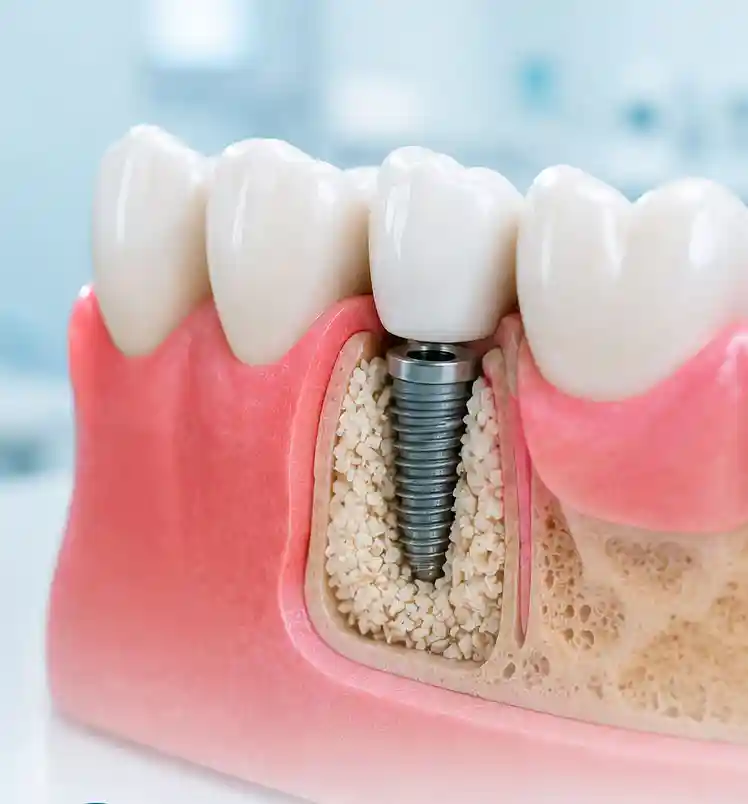
Dental implants are the most effective solution for replacing missing teeth. They replace the tooth root with a titanium fixture in the bone, onto which a crown is placed that mimics the natural tooth in shape and function.
The great advantage of the implant over other solutions is that it preserves the bone: by restoring functional stimulus to the area, it slows the bone resorption that occurs when the tooth is missing. It is also the only solution that does not depend on the neighbouring teeth — it neither grinds them down nor compromises them.
At Clínica Dental Sancho we perform implantology with digital planning and guided surgery, which allows us to maximise precision and reduce the invasiveness of the procedure. We work with Straumann and Neodent implants, two of the brands with the greatest clinical backing internationally.
Bone regeneration — when the bone has already been lost
In some cases, when time has passed since the tooth loss — or when the lost tooth had an infection that gradually 'ate away' the bone around the root — the available bone may be insufficient to place an implant with guarantees. In those situations, guided bone regeneration makes it possible to recover the necessary volume before proceeding with the implant.
It is a predictable technique with good results when planned correctly. Not all cases of bone loss need it, but when indicated, it is what makes a fixed solution possible where it otherwise would not be.
Dental prostheses — fixed or removable
In certain cases, prostheses can be a valid solution. Fixed prostheses — bridges — rest on the neighbouring teeth and do not require surgery, but they involve grinding down those teeth. Removable prostheses are an option when implants cannot be placed for health or bone-volume reasons.
The indication depends on the number of missing teeth, the condition of the bone, the patient's general health and the most appropriate treatment plan for each case. The important thing is not to normalise a missing tooth without a professional assessment.
When to consult the specialist — signs you should not ignore
There are situations in which it is advisable to seek an assessment without delay:
- If you have already lost a tooth and have not yet replaced it
- If you notice mobility in any tooth
- If your gums bleed frequently when brushing
- If you have difficulty chewing or avoid certain foods
- If you have started noticing that your teeth have changed position
- If you have persistent bad breath that does not improve with normal hygiene
- If you feel recurring pain in the jaw, the joint or the ear
The sooner the case is studied, the more options there will be to act in a conservative, predictable and effective way. And the easier it will be to prevent the problem from advancing until it requires more complex solutions.
Conclusion: losing a tooth should never be considered a minor situation
Tooth loss is an oral health problem with functional, structural and, in many cases, systemic consequences. It does not only affect aesthetics. It can alter chewing, favour bone loss, modify the bite, worsen quality of life and compromise general health if its cause is not treated correctly.
Each tooth fulfils a function, and its absence has effects that go far beyond the gap it leaves.
That is why acting in time is key. Identifying the cause of the tooth loss, assessing the condition of the mouth and planning an appropriate solution makes it possible not only to recover functionality, but also to prevent future problems. The options we have today — implants with guided surgery, bone regeneration, digital planning — allow us to approach almost any case with predictable, lasting results.
Frequently asked questions about tooth loss
Can tooth loss affect general health?
Yes. Tooth loss can affect chewing, eating, digestion and the stability of the whole mouth. In addition, when related to periodontal infection, it can be associated with inflammatory processes that impact general health, including a higher cardiovascular risk.
What is the most frequent cause of tooth loss in adults?
Periodontal disease is one of the most frequent causes. Advanced cavities, bruxism, trauma and poor oral hygiene sustained over time are also common. In many cases, tooth loss is the result of several factors accumulated over the years.
What happens if I don't replace a lost tooth?
If it is not replaced, the neighbouring teeth can shift into the empty space, the opposing tooth can over-erupt, the bone in the area starts to resorb and the bite can change. Over time, this complicates treatment and can affect more teeth.
Can bone be lost when a tooth is missing?
Yes. When the tooth root disappears, the bone stops receiving the stimulus of chewing and begins to shrink. It is a frequent and progressive process. That is why it is advisable to consider replacing the tooth as soon as possible.
Do dental implants help slow down bone loss?
Yes. By replacing the root and restoring function to the area, implants help keep the bone in better condition than other solutions that do not transmit functional load in the same way.
What if I don't have enough bone for an implant?
In those cases, guided bone regeneration may be indicated — a technique that recovers the necessary bone volume before placing the implant. Not all cases need it, but when indicated, it opens the door to a fixed solution where it would otherwise not be possible.
Is losing a tooth just an aesthetic problem?
No. Although aesthetics can be affected, the main consequences are usually functional and structural. Tooth loss can compromise the bite, chewing, the bone and overall oral health, with effects that can extend to the body in general.
How long do I have to place an implant after losing a tooth?
There is no universal deadline, but time does matter: the longer you wait, the more bone can be lost and the more complex the solution can become. In some cases the implant can be placed shortly after extraction; in others it is better to wait. The best thing is to consult as soon as possible to plan it correctly.